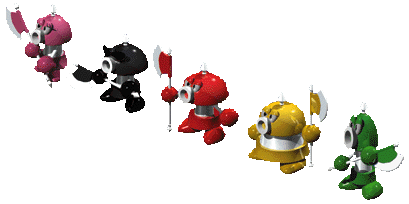
Something I thought was pretty cool were the Axem Rangers from Super Mario RPG: Legend of the Seven Stars. They were based off the Super Sentai series in Japan, which is the basis of what we know as Power Rangers. Being a fan of both, I thought this was pretty cool. Now the only problem is finding a real team that has the same color scheme as the Axem Rangers.
If you have paid attention, then you know that Nintendo has announced Pokemon X and Y for Nintendo 3DS. It is a truly good wonder and sight to look at, especially with the new graphic engine. Pokemon sprites pretty much are gone so far, with the games now having models for the Pokemon. I just look back at how the sprites have advanced throughout the years.
Even these sprites show how far the series has gone.
Speaking of the series, that is what I am planning to do is look back at the past of the series, and possibly have some nostalgia while I'm at it. Please note that I am not going to speak about remakes and will add detail on the third versions of games. Also despite maybe a few rants, none of these are going to be reviews.
1. Pokemon Red and Blue
The first games in the series were Pokemon Red and Blue for the Game Boy. They originally released in 1996 in Japan as Pocket Monsters: Red and Green, and later hit the U.S.shores in 1998. It was a huge success and definitely made the series what it is today. You start out in the region of Kanto and are requested by Professor Oak to complete his Pokedex. To do this, he gives you your first Pokemon. He gives you one of three Pokemon, the grass type Bulbasaur, the fire reptile Charmander, or the water turtle Squirtle.
Throughout your adventure, you take on Gym Leaders, battle the treacherous Team Rocket, aim to be a Pokemon Master, and Catch em All. Kanto is a rather small but interesting region. It also contained some of my favorite places in a Pokemon game. Despite being a low res game, it was a successful games. Also, because of the low res graphics, many of the Pokemon sprites are messed up looking and rather creepy in appearance, and some having errors.
What the crap?!
I don't think I'm sleeping tonight.
I don't trust him.
I don't think that's done right.
Nightmarish elements aside, it was a big impact on game history.
Because it released in 1998, I barely remembered these two games because I was only two at the time. I got into the series when was about three or four by watching the anime. I also remember that Pokemon Red and Blue commercial at the end of nearly each of the video tapes with the evil bus driver.
EVIL! Also, his new Game Boy made by his recycled bus was
apparently more important than his paycheck.
Just in case you are curious, here's the commercial.
I found my copy of Pokemon Red when I was around nine or ten at a community yard sale along with a red Game Boy Pocket to go with it. I had already played Pokemon Fire Red before I played this, but once I picked the Red Pocket up, I couldn't put it down.
Two years after the release of Red and Blue, Pokemon Yellow was released. The game's story was a little closer to the anime. Your starter was a Pikachu that followed you everywhere and even said his own name. Along with this, you could get Bulbasaur, Charmander and Squirtle all in one convenient game and Team Rocket's nearly lovable goofball trio, Jessie, James and Meowth made their own special appearance. Also, each Pokemon sprite went through a complete redo so they looked more like their anime counterparts, so no more creeper coconut trees.
Looks better
Still looks kinda creepy
Like I said, no more creeper trees.
Well they did fix it.
2. Pokemon Gold and Silver
After Red and Blue, Pokemon Gold and Silver were released in 1999 in Japan and 2000 in America. The games could be played on the Game Boy, but it was better to play on the Game Boy Color. The game takes place a few years after the events in Red and Blue. The story takes place in Johto, a neighboring region next to Kanto. You are asked by Professor Elm to run an errand for him and afterwards the adventure pretty much unfolds. One hundred new Pokemon were introduced in these games, including the three starters, Chikorita, Cyndaquil, and Totodile.
Once again, you battle gym leaders and catch all the Pokemon. Team Rocket makes a big return in the game. One new feature in these games is the clock feature, which helps keep time in the game. Because of this, there is also a day/night feature, in which the surroundings in game would be rather dark in appearance. Certain Pokemon also only came out at night. It was a nice little touch that didn't get recognition again until Pokemon Diamond and Pearl.
In 2000 in Japan, Pokemon Crystal was released, this time, it was a Game Boy Color only exclusive. The main Pokemon in the game was Suicune, one of the Pokemon in the Beast Trio. Here they are below with Suicune being the bottom one.
Very little was changed in the third version. One in change is the Pokemon sprites now being able to move before battle.
A new character was added in the game and is pretty much the reason Suicune is so important in the game. His name is Eusine, who is pursuing Suicune around Johto and Kanto. Along with these little changes, Crystal is the first Pokemon game to let you choose between a male and female protagonist.
3. Pokemon Ruby and Sapphire
Pokemon Ruby and Sapphire were released in 2002 in Japan and in 2003 in America and was released on the Game Boy Advance. Ruby was personally my first Pokemon game and was full of wonders. The games take place in Hoenn, a large and tropical region home to many new Pokemon. You start in Littleroot Town as the new kid in town. After some exploring, you meet Professor Birch, who is embarrassingly being chased by a Pokemon. Leaving his bag in front of you, you must choose between the wood gecko Treecko, the chick Torchic, or the mud fish Mudkip.
The day/night feature was taken out of Ruby and Sapphire, but the clock feature was kept. Instead of what it was normally used for, it was used for a new thing called berry planting. In the games, the player could find berry bushes and pick the berries. Using the soil where a bush once stood, players could plant berries and grow their own bushes. However, they didn't grow instantly. That's what the clock was for. Hoenn was also fill with different weather conditions, from sandstorms to rain. It is also the only games to have version exclusive evil groups. In Ruby, the player had to stop Team Magma from plaguing the world with droughts using the Continent Pokemon Groudon.
In Sapphire, the player had to stop Team Aqua from drowning the world with the Sea Basin Pokemon Kyogre.
In 2004 and 2005, Pokemon Emerald was released with a few alterations. Pokemon had moving sprites again, but they weren't as cool as Crystal's.
Team Magma and Aqua are both villainous teams in this game, both with the same plots as before, only for them to go horribly wrong. Also, this game introduced the Battle Frontier, a nifty and interesting place with seven facilities, each with its own way of battling.
4. Pokemon Diamond and Pearl
Pokemon Diamond and Pearl was released for the DS in 2006 in Japan and 2007 in America. Thanks to the DS quality, the worlds in the game were more 3D and were pretty cool. The game takes place in Sinnoh, a large region known for its mythology. Your adventure starts when you and your rival meet the professor and his assistant, only to find that they left their bag containing the three starter Pokemon behind. When you are attacked by wild Pokemon, you must then choose between Turtwig, Chimchar and Piplup.
The day/night feature returned in these games, which meant that Zubat can ambush you at night. Sinnoh was one of the largest regions in any Pokemon game, giving a rather large amount of territory to explore. Some like and some hate, but I like it. One main annoyance among many about these games were the slow frame rate. It really didn't bother me, but I will admit that it was annoying to surf because of it. In game, the player must stop the dangerous Team Galactic from gaining control of time or space.
In 2008, Pokemon Platinum was released in Japan. Once again, there are changes. One main one was that the frame rate was polished a little bit, making the game less slow. One of my favorites was the extra Pokemon added to the Pokedex. Team Galactic is back, but this time is after the Renegade Pokemon Giratina.
The Battle Frontier also reappears in Platinum, but in my opinion, it wasn't as impressive as the one in Emerald.
5. Pokemon Black and White
Pokemon Black and White were released in 2010 in Japan and 2011 in America. The game takes place in the rather small region of Unova, which is a significant region because it is not based off of Japan, but instead it is based on the New York area. It was released on the DS and was enhanced for the DSi. The graphic engine was polished for this game, making the 3D graphics more impressive than Diamond and Pearl. Your adventure starts right at the start of the game when you and your best friends are waiting for the professor to deliver three Pokemon to you. Once you get them, you then can choose between the snake Pokemon Snivy, the pig Pokemon Tepig, or the otter Pokemon Oshawott.
The game mainly focuses on Team Plasma, a group who wishes to liberate Pokemon. Their leaders are a kid named N, who has the ability to talk to Pokemon, and his guardian Ghetsis, though Ghetsis is kinda shifty. None of the past Pokemon appear in the Unova Pokedex, all of them being new. Because of how small the region being so small, there really isn't much to explore. Also, because of this, many things were left unanswered.
6. Pokemon Black 2 and White 2
Now I know I said I wouldn't be talking about the third version of games barely, but this is a continuation of the original story. These recent games released in June 2012 in Japan and October 2012 in America. These games take place two years after the events in Black and White and continue the untold story. These games take place once again in Unova with many new places to explore. Once again, you choose between Snivy, Tepig, or Oshawott. Team Plasma appears once again, this time, stealing Pokemon for Ghetsis. The Pokedex was once again expanded, including Pokemon from each of the past generations. The main Pokemon in both games is the Boundary Pokemon Kyurem.
Along with this game was the eShop exclusive, Pokemon Dream Radar, a 3D AR shooter game used to catch Pokemon. It is needed to complete the Pokedex because it is the only way to get the Kami Trio for Black 2 and White 2.
And there we have it. This was the look back at the past of Pokemon. With X and Y on their way, who knows what will happen in the series.
As we may already know, the 25 year old Nintendo magazine, Nintendo Power, has hit its final chapter. To show my respect, I have put together a little something together.
Rest in peace, Nintendo Power. From your humorous articles to your Chuck Norris and Mr. T jokes, you were always a big joy for me. My heart always skipped a beat every time I found one of your magazines in my mailbox. Every little detail was at its best. You will be forever known by fans and will be dearly missed.
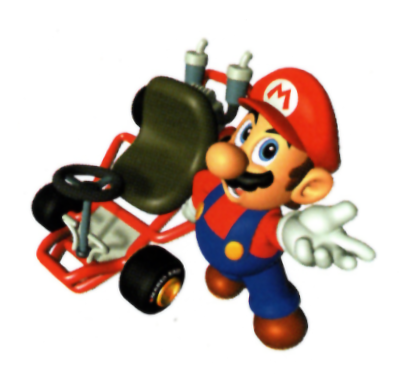
August 27 marked the 20th anniversary of the Mario Kart series. To celebrate, I plan to talk about the seven Rainbow Roads. So go on and enjoy.
1. Rainbow Road- SNES
This is where it all started back in 1992. It was in the first game, so it is going to look basic. However, that doesn't make it easy. There are absolutely no barriers on the edges of the road, so it is fairly easy to fall off. Also, flashing, invincible Thwomps appear all over the place. Running into one causes the racer to spin completely out of control. Like other Super Mario Kart tracks, it appeared in Mario Kart: Super Circuit. It is still very fun just like its follow ups and is playable as a Retro track in Mario Kart 7 .
2. Rainbow Road- N64
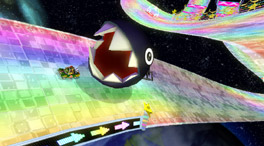
Rainbow Road pretty much evolves in Mario Kart 64. It is officially the longest track in Mario Kart history, taking almost six minutes to complete three laps. It is fun, however, it is slightly easier than the Rainbow Road in Super Mario Kart. Mostly because barriers cover the whole tracks. It is not a harmless track, though. First, Chomps invade the track and are fairly hard to dodge. Second, gravity is a lot lighter, so it is a lot easier to fall off of a ledge. What I like about this one are the neon racers that appear throughout the race. Also, this track made a neat appearance in F-Zero X, with a metal remix of the original N64 music only in the Japanese version.
3. Rainbow Road- GBA
This track was slightly dumbed down, but it was for the Game Boy Advance. It had a few barrier, but was still a hard to control track. There were a few surprise turns and a few sharp ones. Shooting stars tend to fall on certain parts of the track. Hitting one would make the racer spin out of control. Small thunder clouds also appeared. Running under while it goes off causes the racer to shrink. A fun easter egg is the Bowser's Castle from Paper Mario appearing in the background.
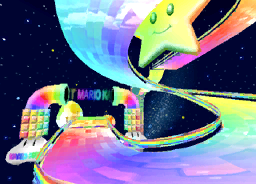
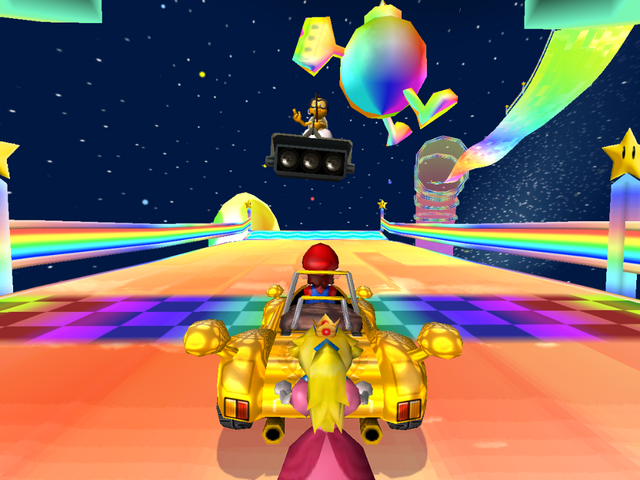
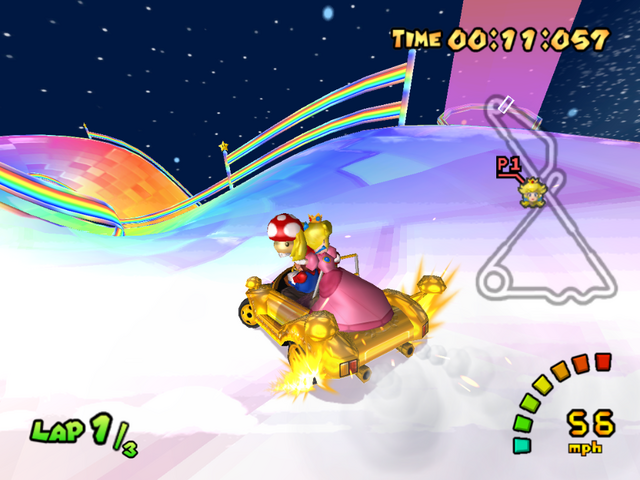
4. Rainbow Road- GCN
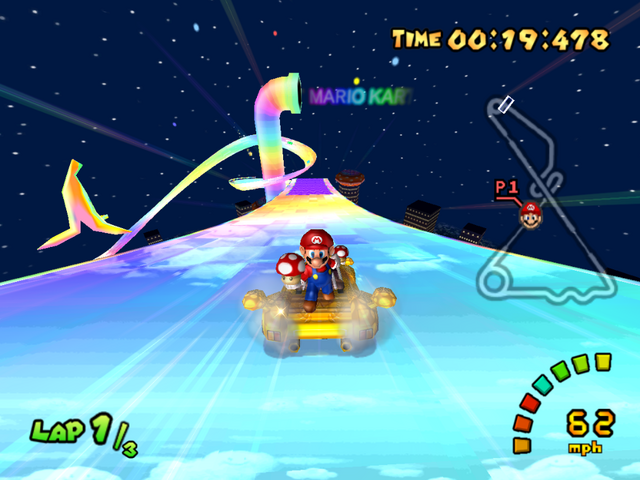
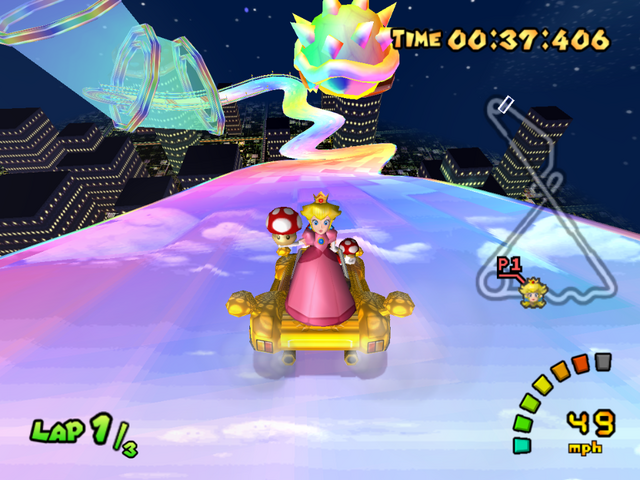
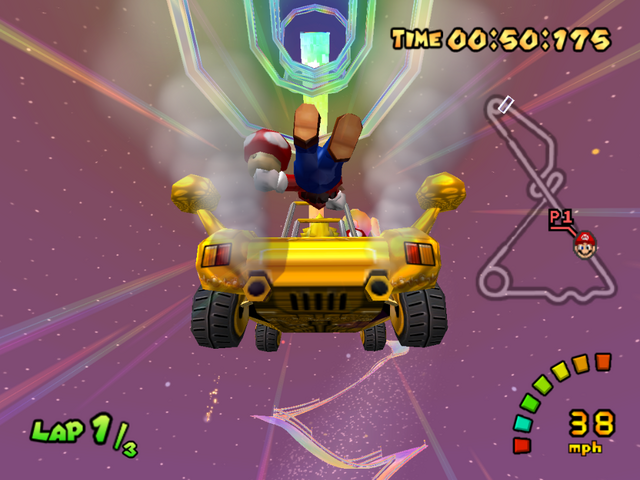
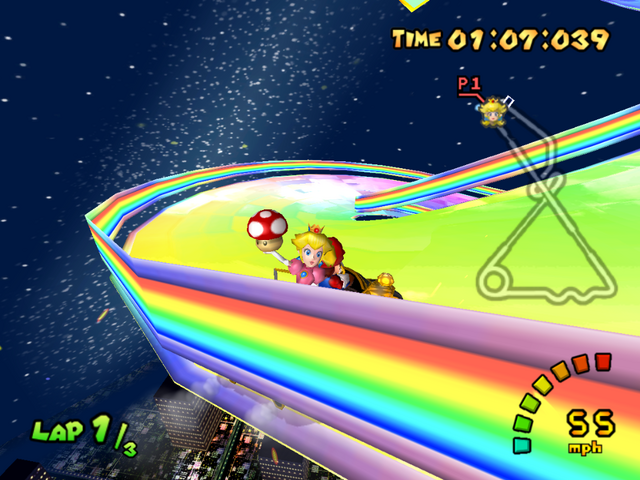
This track is very good. One reason is that it is over Mushroom City, while the version in multi player is in space. It can be a fairly difficult track depending on how experienced you are. Throughout the track, rainbow statues of various items appear throughout the track, similar to the neon racers in Mario Kart 64's Rainbow Road. While I'm talking about that Rainbow Road, part of the music in this Rainbow Road is actually a remix the the 64's Rainbow Road, which is always welcomed by me.
5. Rainbow Road- NDS
Despite not being as decorative as previous incarnations, this track is still just as enjoyable as any other Rainbow Road. The track barely has any obstacles, but barely any guardrails as well. It contains may loops and corkscrews that gives it a roller coaster feel. This is pretty unique because it is so far the only Rainbow Road to contain any real loops in it. Also, the rainbow pattern is slightly different than in previous Rainbow Roads. Instead of the stripes crossing the track, they instead follow the track.
6. Rainbow Road- Wii
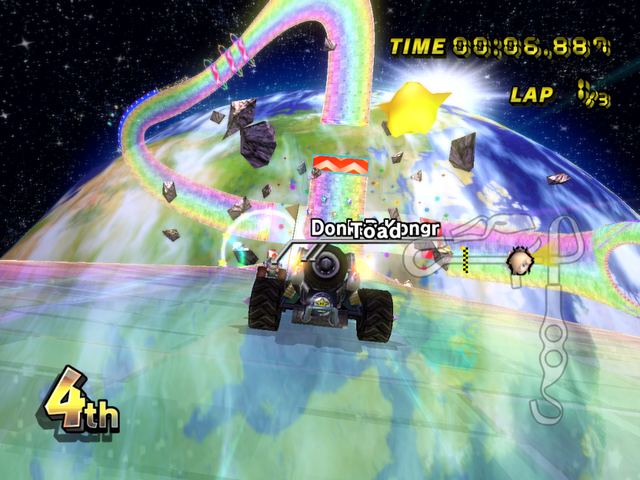
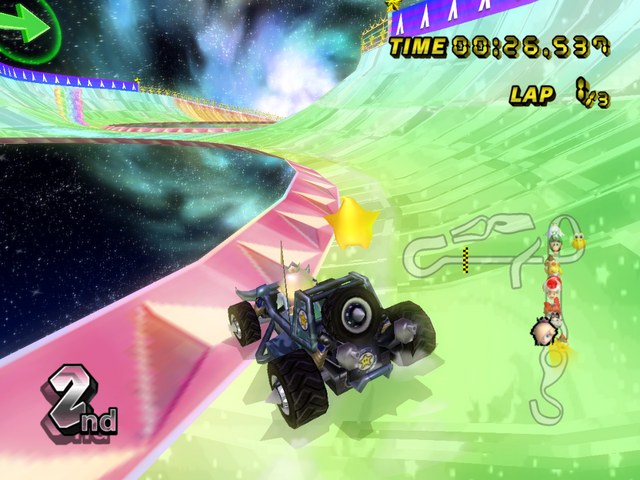
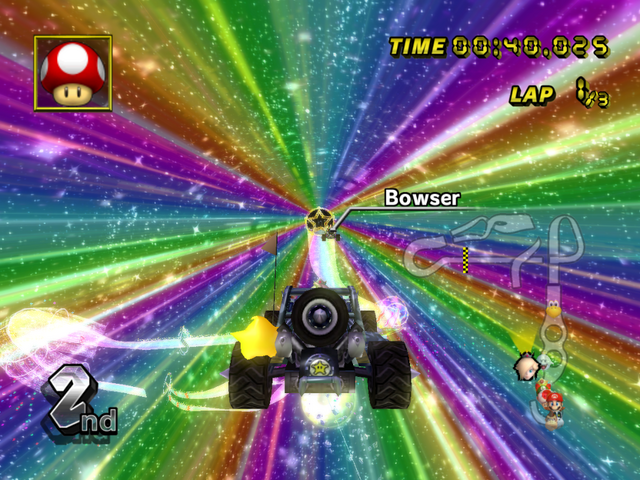
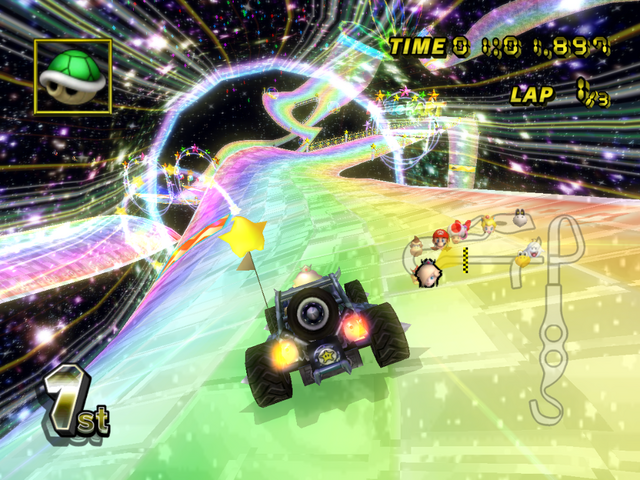
This one indeed shows the difference between Mario Kart Wii and Super Mario Kart. This Rainbow Road contains many turns. It takes place above Earth, in which different parts of North America, Europe, Africa and South America can be seen. And interesting twist in this race is if a racer fall off the track, they will fall towards Earth and burn up in the atmosphere before being picked up by Lakitu. There is also a Star tunnel that acts very similar to cannons in the game. This track also has small Super Mario Galaxy references to it, such as a small Super Mario Galaxy remix in the music and floating Star Bits seen in the space.
7. Rainbow Road- 3DS
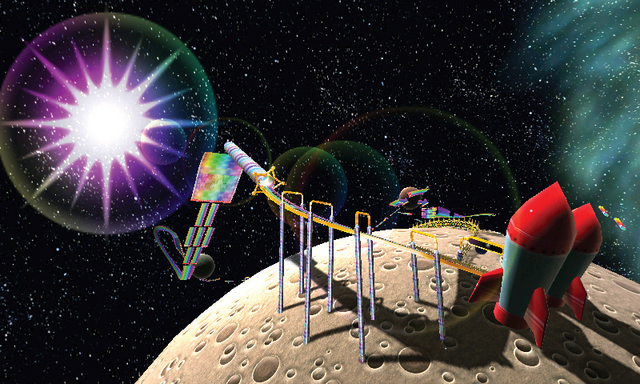
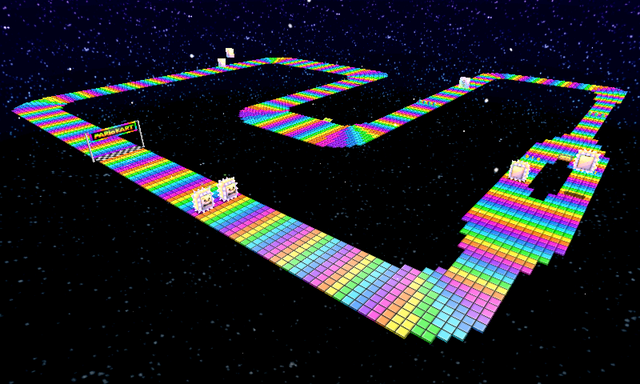
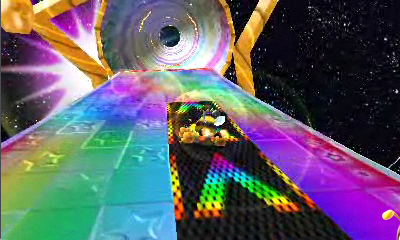
This track is a real improvement. Like a few other long tracks in Mario Kart 7, it only has one lap and is divided into three sections. It is also the first Rainbow Road to have an area that is not on a rainbow, but instead on a moon. On this moon, the gravity fairly light. There are also a few craters that can be used as ramps. Rolling Chain Chomps invade the moon and can run into the racer. Asteroids can also hit a racer in the last section of the track. The music is a remix to Double Dash's Rainbow Road, so that also means a remix to Mario Kart 64's Rainbow Road. Actually, the last section's music is pretty much a sped up remix to 64's Rainbow Road.
And there we have it. As an added bonus, I have decided to add a gallery of the Rainbow Roads. All pictures used belong to Super Mario Wiki.
Super Mario Kart
Racing on Rainbow Road
As it appears in Mario Kart: Super Circuit
Ariel view of the track in Mario Kart 7
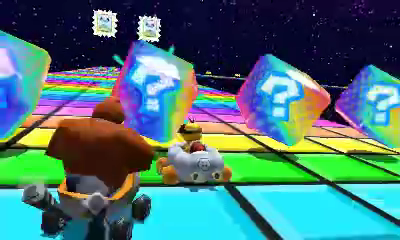
Racing on the track in Mario Kart 7
Mario Kart 64
Icon for the track
At the beginning of the track. Also note
the neon Peach face and half of neon Mario
face
One of the Chain Chomps and Toad's
neon
The track's appearance in F-Zero X
Mario Kart: Super Circuit
The track's icon
Start of the track. Note Bowser's Castle in the
background
Mario Kart: Double Dash!!
The track's logo
The track's icon
The tracks start, with rainbow statues
of a Bob-omb and a Yoshi egg
An upcoming u-turn
A straight road and a rainbow statue
of a banana peel
An upcoming swirly path and a rainbow
statue of Bowser's shell